Phase 1 Product · Now Available for Pre-Order

VartaSDR

VERSION 1.0  ·  Next-Gen HARDWARE SDR

A purpose-built software-defined radio with a 16-bit ADC, onboard Linux, Gigabit Ethernet with PoE, and phase-coherent multi-chip sync. Built for counter-drone. Ready for anything.

Shipping: September 2026
Pricing on request — contact us for early access
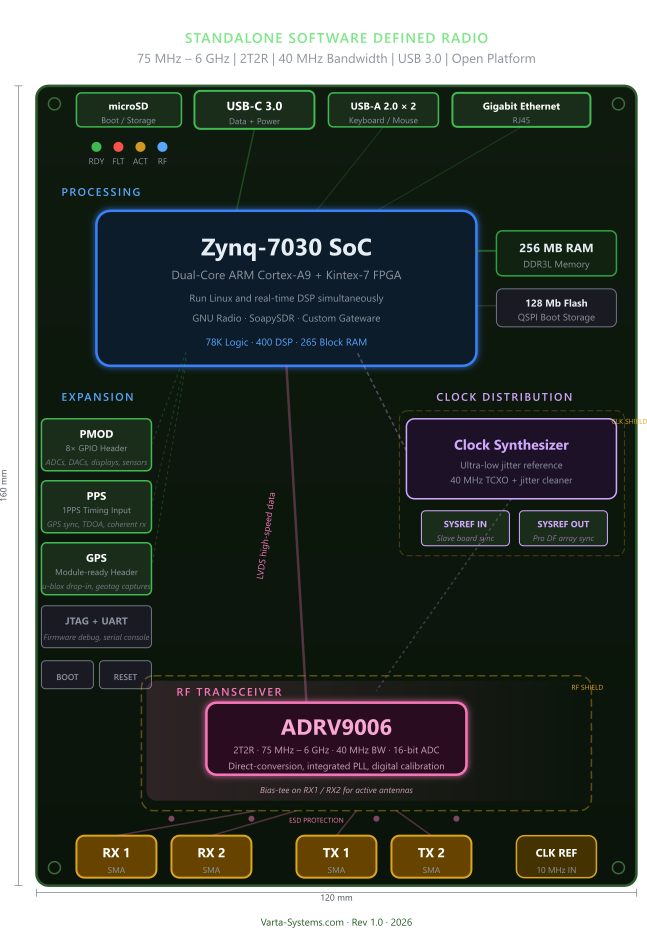
VartaSDR 1.0 block diagram — Zynq-7030 SoC, ADRV9006 RF transceiver, Gigabit Ethernet, GPS/PPS, PMOD expansion
75 MHz–6 GHz
Frequency Range
16-bit
ADC Resolution
40 MHz
Inst. Bandwidth
2T2R
Full-Duplex Channels
GigE
Network Interface
Standalone
No Host PC Required
Why It's Different

Hardware gaps the market left open

Most SDRs cut corners on resolution, connectivity, or compute. We didn't pick one to fix — VartaSDR fixes all three.

📡

16-bit ADC
+24 dB Dynamic Range

Every other board in this price range uses a 12-bit ADC. We used 16-bit. That's +24 dB of headroom — enough to pick up a drone while a jammer is screaming on the same frequency.

vs. 12-bit ADCs: +24 dB dynamic range advantage
🔗

Gigabit Ethernet
No More 3m USB Leashes

USB tops out at 3 meters. That's a leash. GigE runs 100m over a standard cable, plugs into any network switch, and keeps latency under 1 ms. Deploy your sensor where it actually needs to be.

100m cable runs · network switches · <1 ms latency

Zynq 7030 SoC
Run Linux. No Host Required.

There's a full Linux computer on this board. Plug in power, it boots, runs your software, and streams data — no laptop required. GNU Radio, custom FPGA pipelines, whatever you need.

400 DSP slices · dual A9 cores · full Linux stack

🕐

GPS / PPS Timing

Plug in a small GPS module and the board knows exactly where it is and what time it is — down to the nanosecond. That's how you locate a drone using multiple sensors spread across a site.

🔄

Multi-Chip Sync

Stack multiple boards and they stay phase-locked within a nanosecond of each other — in hardware, not software. That's what makes direction-finding arrays actually work.

USB-C or PoE. Your Choice.

On the bench, plug in USB-C. Mounted on a pole or rooftop, use PoE — power and data come down the same Ethernet cable you're already running. One cable to the board, nothing else.

🎯

Built for C-UAS

VartaSDR was designed alongside the platform, not bolted on after. It slots straight into Mini, Pro, and Max tiers — no adapters, no workarounds.

🔌

5V Bias-Tee Built In

Need to power an external LNA amplifier on your antenna? The board outputs 5V on the RF port — no adapters, no extra cables. Connect the antenna and it powers the LNA automatically.

How We Stack Up

Not a marginal improvement — a different class of hardware.

Built from the ground up. The spec sheet shows it.

Feature Other SDR — Mid Range VartaSDR 1.0 ★ Other SDR — High End
ADC Resolution 12-bit (72 dB) 16-bit (96 dB) 12-bit (72 dB)
Network Interface USB 3.0 only (3m) Gigabit Ethernet + USB 3.0 USB 3.0 only (3m)
Power Input USB only USB-C or PoE (802.3af) USB only
On-Board Processing Cyclone V (no ARM) Zynq 7030 + dual ARM A9 Spartan-6 (no ARM)
Standalone Operation Host PC required Runs Linux independently Host PC required
Multi-Chip Sync None SYSREF MCS <1 ns None
GPS / PPS Timing None Onboard ($12 module) Requires external GPSDO module
Bias-Tee (LNA power) Sold separately Built-in 5V on 2 RX ports Not available
Operating Temp 0 to +70°C 0 to +70°C 0 to +45°C
Target Applications

Where VartaSDR excels

Engineered first for counter-drone. Capable across the full spectrum of SDR applications.

01

Drone & RF Detection

VartaSDR was purpose-built for this. Mount one at your perimeter, power it over PoE, and it starts scanning. Add a second or third board on the same network switch — each one locks to within 1 nanosecond of the others via hardware SYSREF clock distribution. That synchronization is what enables TDOA (Time Difference of Arrival) geolocation: when a drone transmits, each sensor captures the signal at a slightly different time, and the math pins where it is. No cooperation from the drone required. Just physics.

02

Persistent Spectrum Monitoring

Bolt it to a rooftop, connect power and Ethernet, and walk away. VartaSDR runs headlessly — no laptop, no babysitting. It logs what it hears, flags anomalies, and reports back over the network. PoE means one cable does everything. 40 MHz of instantaneous bandwidth means you're not missing activity between sweeps.

03

GNU Radio & Open-Source SDR Platform

GNU Radio and SoapySDR run natively on the board — no host PC in the loop. SSH in, launch your flowgraph, and it runs on the Zynq SoC's ARM cores with 400 DSP slices and 40 MHz of live RF bandwidth. Build custom demodulators, process protocol frames, or just explore the spectrum. The board is the computer.

04

Cellular & 5G Network Testing

Coverage mapping, interference hunting, and signal quality analysis across LTE and 5G bands. Network operators use wideband SDRs to find dead zones, identify interference sources, and validate site performance — without expensive purpose-built analyzers that do the same thing for 10× the price.

05

Satellite Ground Stations

Receive CubeSat telemetry, decode NOAA and GOES weather satellite imagery, and verify LEO downlink performance. The 16-bit ADC gives you the dynamic range to pull clean captures from weak satellite signals that lower-resolution boards simply clip and drop.

06

RF Compliance & Pre-Certification Testing

Catch emissions problems before you pay for an accredited test lab. Validate that your wireless product transmits at the correct frequency, power level, and spectral mask — in-house, early in development, when a fix costs hours instead of weeks and another lab booking.

Technical Specifications

Full spec sheet

VartaSDR 1.0 — PCB design underway, specifications subject to minor revision before production.

RF Performance
Frequency Range75 MHz – 6 GHz
Instantaneous Bandwidth40 MHz
Channels2T2R (full-duplex capable)
ADC / DAC Resolution16-bit
Max Sample Rate61.44 MSPS
RX Noise Figure3–4 dB (internal LNA) · <1.5 dB (ext. LNA)
RX IIP3>+20 dBm
TX Output Power+6 dBm (direct)
Narrowband ModeDown to 12 kHz channel bandwidth
Bias-Tee5V DC on 2 RX ports (GPIO-controlled)
Processing & Memory
FPGA / SoCXilinx Zynq XC7Z030 (125K logic, 400 DSP48, dual Cortex-A9)
RAM256 MB DDR3L
Storage128 Mbit QSPI + microSD slot
Connectivity & I/O
Ethernet10/100/1000BASE-T (DP83867 PHY)
USBUSB 3.0 data + UART console + USB-C PD power
GPS / PPS1PPS header (3.3V LVCMOS)
GPIO8-pin PMOD (SPI, I2C, UART, digital)
Clock Reference10 MHz REF IN (SMA) for MCS distribution
Physical & Environmental
Board Size100 × 80 mm
Power InputUSB-C (PD) or PoE 802.3af — single cable for power + data
Operating Temperature0 to +70°C

Ready to get your hands on one?

VartaSDR 1.0 ships September 2026. Contact us for early access, evaluation units, or integration partnerships. Volume pricing available for deployments of 5+ units.